
How to Help Your Child Memorize Math Facts (Without Screens)
September 16, 2026 · 5 min read
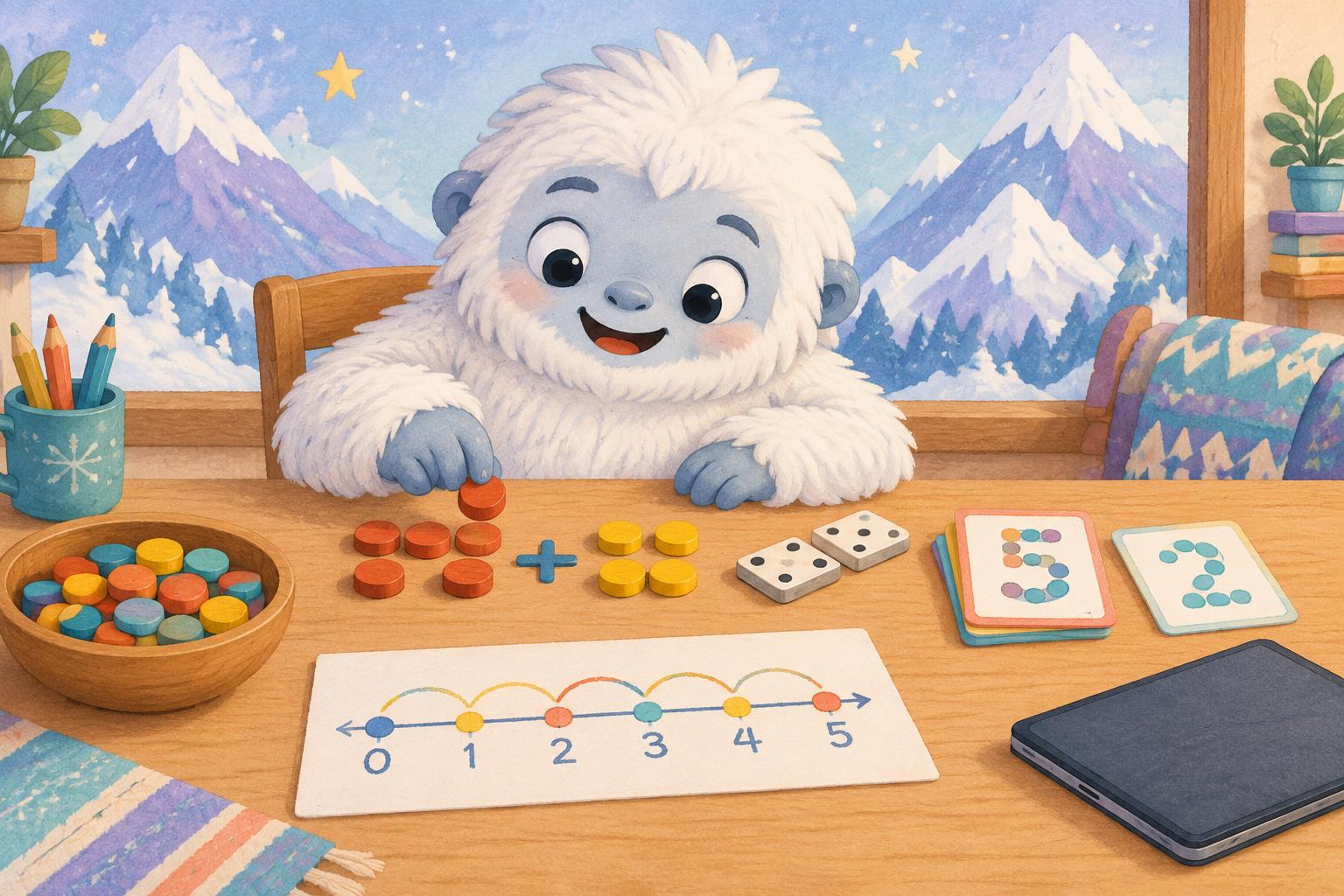
Helping your child learn math facts does not have to mean more screen time, endless worksheets, or frustrating drills.
At Supernova Kids, we believe strong math fact fluency comes from understanding first, practice second, and confidence all the way through. That is the spirit behind Reti the Yeti: helping children see math as something they can explore, understand, and enjoy.
Children do not simply need to memorize that 8 + 9 = 17—they need strategies that help the answer make sense and tools they can use when their memory gets stuck.
Here are a few screen-free ways to help.
Teach one trick at a time
When introducing a math strategy, work on that trick in isolation first.
Review the strategy together, practice it with flashcards, and then complete a few problems on paper. Once your child feels comfortable, look for ways to use that same strategy in other math work.
For example, if your child is learning the “plus 9” trick, they may learn to add 10 and then subtract 1. That strategy can later support larger addition problems and regrouping, too.
The goal is not just to remember a fact—it is to build a dependable way to solve it. This is the kind of confident, playful problem-solving Reti the Yeti encourages: use what you already know to unlock the next challenge.
Remind them of the strategy before they count
When a child gets stuck on a math fact, it is natural for them to want to count on their fingers. Instead of immediately giving the answer, gently point them back to the strategy they know.
You might say, “Hey, isn’t that a plus 9?” or “What trick could help us with this one?”
This small reminder helps children shift from counting every time to using efficient math thinking. The more often children successfully use a strategy, the more they begin to trust themselves as mathematicians.
Use models—no catwalk required
When a child gets stuck, ask them to model the problem.
A model can be a drawing, a number line, place-value blocks, counters, a domino pattern, or even small objects from around the house. There are endless ways to make a math problem visible.
For example, if a child cannot solve 14 - 6 in their head, draw a number line and hop back six spaces. If they are learning place value, use blocks or coins to show tens and ones.
Models help children see what the numbers are doing. Once the idea makes sense, memorization becomes much easier. Reti the Yeti’s playful learning adventures are built on that same idea: make math meaningful, visual, and approachable.
Think out loud
One of the most powerful things adults can do is let children hear the thinking behind the answer.
Try saying something like: “I see 7 + 8. I know 7 + 7 is 14, so one more makes 15.”
When you think out loud, your child gets a window into how a mathematician approaches a problem. They learn that good math thinkers do not always know the answer instantly—they use what they know to figure out what they do not know yet.
Activate their schema
Just as readers warm up by reviewing phonics patterns, mathematicians benefit from a quick warm-up, too.
Before introducing a new strategy, think about what your child needs to know first. For example, before working on the Doubles +1 strategy, review doubles facts together: 2 + 2, 3 + 3, 4 + 4, and so on.
Once those facts feel familiar, explain that a problem like 6 + 7 is simply one more than 6 + 6. If your child knows 6 + 6 = 12, they can add one more to get 13.
This is called activating schema: connecting new learning to what a child already knows. A quick review of doubles facts gives children a sturdy foundation for learning Doubles +1 with confidence.
Build confidence, not pressure
Math facts are important, but speed is not the only measure of success. Give your child time to think, celebrate strategy use, and make mistakes feel safe.
With consistent practice, helpful models, and strategies they truly understand, math facts begin to stick—without a screen in sight. And when learning feels like an adventure, children are more likely to keep going. That is the world Reti the Yeti is here to create.